Charm Casting: Part 3 - Making and Finding Maps
There are some premade maps out there - Xia Hunt has a few and Etsy of course will provide - but you can make your own for even more customization goodness, or use things you already have.
A good map has divisions by subject/theme, time, or another factor that tells you where to look for the influence of each charm in your life. It's also sized appropriately for your charms; I like 10x10" or 12x12" maps. Using a larger map or one with larger divisions means you can use larger charms, but also that you need more space.
My go-to maps use my color system to break things up into 13 categories and the smallest sections are about as wide as my longest charms: 20mm or so. One of my other maps represents the 5 elements of fire, air, water, earth, and spirit; it's the same size overall (10x10") so the 5 sections are larger and I could hypothetically use bigger charms if I wanted to.
I made those maps, but you can also use a calendar to tell what day of the month things will happen or actions are needed. You can cast on top of a Tarot, oracle, Lenormand, etc spread as I think I've already mentioned; the charm's meaning influences the card it lands on.
You can even bring food into it - Josie Helasdottir and I came up with the idea of using a salad as your map, making lines with dressing to mark the sections, and sprinkling small amounts of different toppings to serve as charms. Then you eat the salad to take in the energy of the reading. Focaccia bread, pizza, or a very large cookie could also work, although I don't think I'd want to eat a pizza or giant cookie by myself. Maybe it would be better for a group reading. 😄
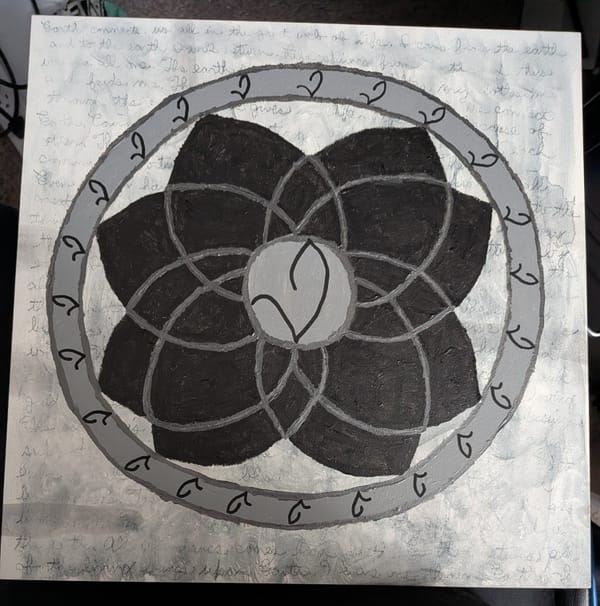
If you find the idea of creating a more permanent map appealing or can't find a premade map that suits you, I suggest starting with a temporary version on a big sheet of paper or a piece of cardboard. A pizza box lid and a Sharpie will work fine. If you can't draw straight lines or circles, then draw around rulers, plates, and jars.
For map design, consider what kinds of questions you expect or want to get. What information is relevant to those questions? Do you think you should have a section of the map for that, or is it going to be covered by the charms that turn up?
After you use your temporary map a few times and make any adjustments you want, I recommend Ampersand gessobord or aquabord as a permanent surface - gessobord is suitable for acrylics and aquabord for watercolors. Blick Art Materials also has a house brand similar to gessobord and it's just as good to me. I've heard that canvas panels tend to warp over time, so I haven't used those.
If you're painting with acrylics, the shininess of regular acrylic tends to interfere with taking good photos of your castings. Use matte acrylics if you can; Golden SoFlat is the type that's worked the best for me, although the price is on the higher end. Using acrylic markers for lines is fine; they aren't going to cover enough area for the shininess to matter much. But I advise using matte varnish to seal your painting.
There's one more charm casting tool that I want to discuss along with maps, and that's a shadowbox or other box for casting into. The walls of the box prevent charms from scattering everywhere. Obviously, you need a box that your maps can fit into. Also, you can paint a map in the bottom of your box if the surface permits.
My current box is a 12x12" Ampersand one that came unfinished; I painted one of my maps straight into it. The dimensions of the Ampersand shadowboxes are the outer dimensions, so I have to use 10x10" gessobord when I drop a different map in for casting.
If you would rather get a finished shadowbox from somewhere like Michaels, the dimensions given are probably the inner dimensions, so a 12x12" shadowbox of this type would hold a 12x12" map. It needs to be front loading, which means the side that opens is the one with the glass, not the back.
When I used a shadowbox like this, I removed the back cloth and padding to get more depth and replaced it by gluing in a piece of scrapbooking paper. I'm not sure if that was worth it; it was a lot of work to get all of the foam padding out and the resulting surface had glue left on it, so it wasn't suitable for painting onto.
A small suitcase-type box might also be suitable depending on the dimensions, and could double as a carrying case. Part of charm casting, for me, is the mindset of looking at unrelated objects and considering whether they could be useful. Don't rule out a potential map or box just because it was meant for something else!