Charm Casting: Part 1 - What is it and why do it?
This series of posts is largely based on a class I taught at Ann Arbor Pagan Pride Day 2024. I'll expand on how to interpret a casting from what was presented at the time.
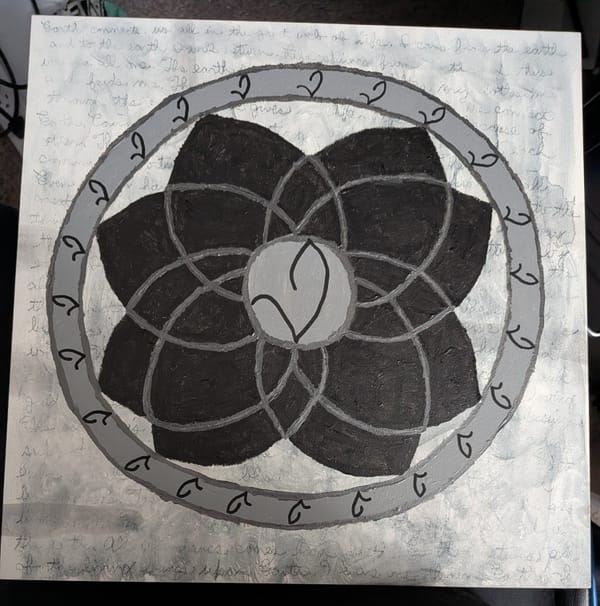
Charm casting is a form of divination in which small objects (charms) are dropped onto a marked surface (map). The charms are interpreted based on where they land on the map, what else is nearby, their orientation, etc.
The first advantage to this method is that it's completely customizable. You get to decide what charms you use and what they mean. If you want a charm casting set for a specific type of question, you can make one. If you want to be able to answer on a variety of topics, you can. And if you already work with runes, ogham, or a similar set of predefined symbols, you can incorporate those too.
The second advantage is that you can get a lot of information from it, and even decide how much information you want. I normally read with 30-50 charms and it takes about 90 minutes to set up, read, and tear down. One of my teachers showed a 100+ charm cast that she photographed and was still going back to for more information, months later. If that's information overload for you - it is for me! - you can use less charms.
Charm casting can also be combined with card divination like Tarot or Lenormand; you grab a few charms and cast them on top of your card spread.
You might not want to use charm casting if you'd rather not have to define everything yourself, or if dozens to hundreds of little objects to track seems overwhelming. I have a way of helping to ensure they don't fly everywhere, though, which I'll cover when I talk about supplies.
The biggest frustration I have with charm casting has to do with the fact that I separate some of my charms into categories, using some of those charms all of the time, some of them when they're relevant to the question, plus a random collection of uncategorized charms at the same time. That means I have to put the categorized charms back in specific places after a reading so I can find them again next time. But you can choose to do things differently if you find this too frustrating. For me, it's worth the annoyance.
When should you use charm casting? If the question or subject fits into the theme of your set and you want a variable or high amount of information, and you're willing to spend the amount of time it takes you to analyze the number of charms you'd use, it may be a good idea.
I also find that using a specific map and/or pulling specific charms to use can help me answer specific questions. For example, I have a zodiac wheel map that I can use to determine if something will happen in the next year and what sun sign's season it will happen in. I would choose a charm that symbolizes that event and see if it lands in one of the 12 segments for the signs (that's when it will happen), in the neutral area in the center of the map (it'll happen but maybe take longer than a year), or off of the map (it won't happen in a year).
Next time, I'll talk about supplies, including how to choose good charms, some ways to make or find a map, and that method for preventing runaway charms that I mentioned.